drivers
This python module provides methods to drive NEML material models in loading conditions representative of common experimental tests.
Uniaxial tension
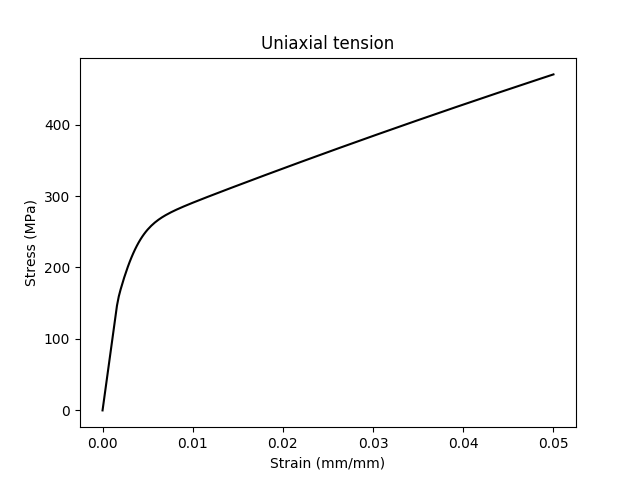
This routine produces a uniaxial tension (or compression) curve for a NEML model.
Strain controlled cyclic
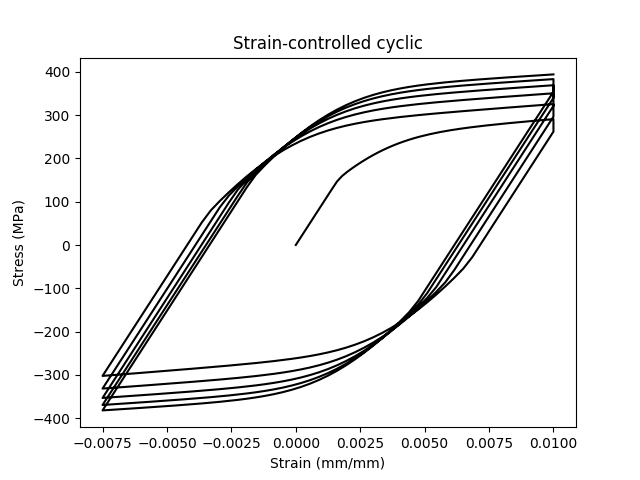
This routine mimic a strain controlled cyclic test, with or without holds on the maximum tension and compressive strains.
Strain controlled cyclic with follow up
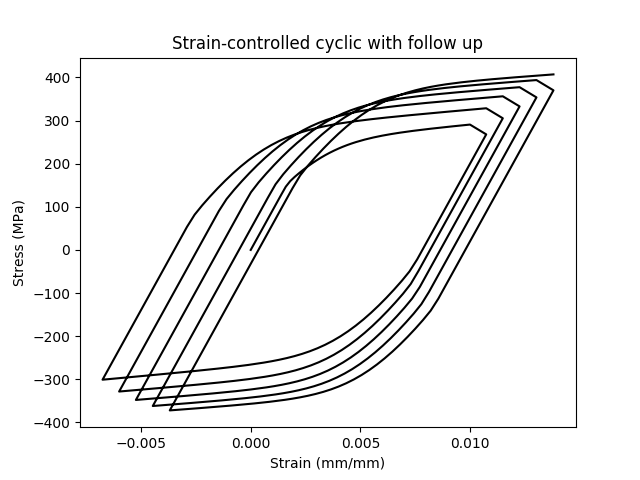
This routine mimic a strain controlled cyclic test, with or without holds on the maximum tension and compressive strains. This version can impose some known elastic follow up on the stress relaxation parts of the cycle.
Stress controlled cyclic
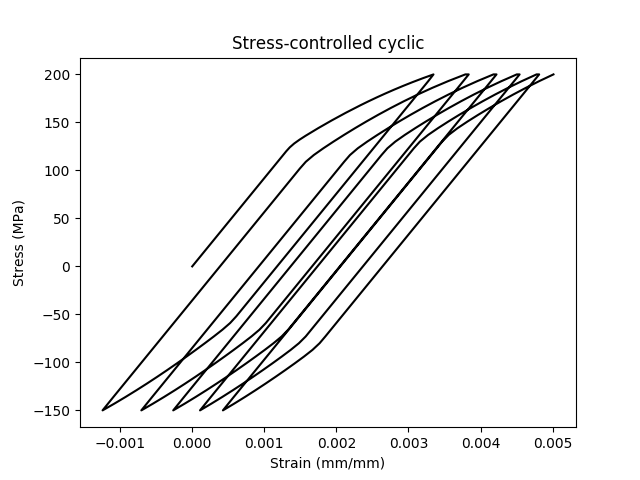
This routine mimic a stress controlled cyclic test, with or without holds on the maximum tension and compressive strains.
Stress relaxation
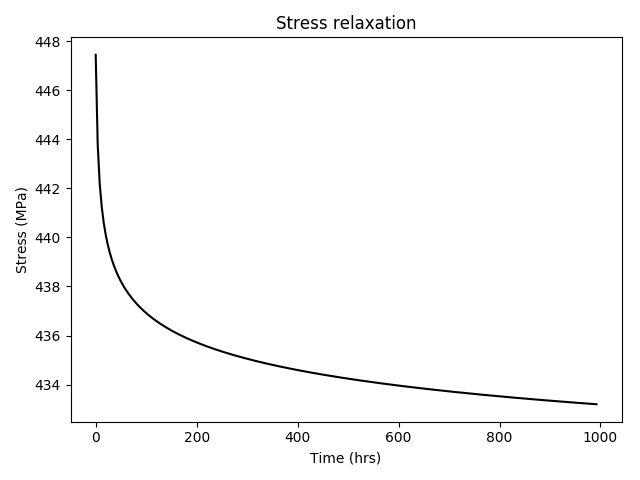
This routine simulates a stress relaxation tests where the sample is loaded under strain control to some strain level and then then strain is held constant and the stress allowed to relax.
Creep
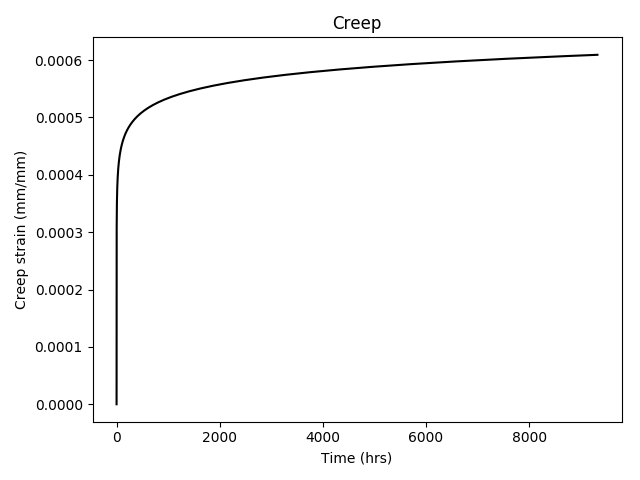
This routine simulates a creep test where the sample is loaded to some stress under stress control and then the stress is held fixed as the strain increases.
Strain rate jump test
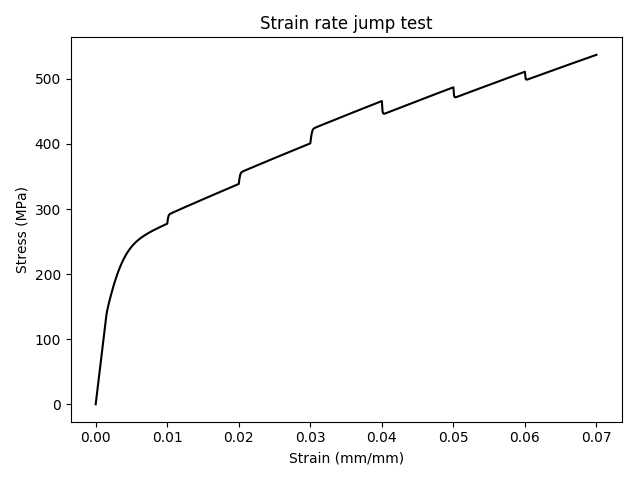
This routine simulates a strain rate jump test. The specimen is under uniaxial stress and strain control, like a standard tension test. However, at certain times during the test the strain rate is either increased or decreased, causing a jump in the flow stress for rate sensitive materials.
Isochronous stress-strain curve
This routine generates an isochronous stress-strain curve for a model
and for a given time and temperature.
Isochronous stress-strain curves are a method for summarizing
a collection of creep tests at the same temperature for the same material.
The isochronous stress-strain curve is the locus of (strain,stress) points
the material passes through at time  during the collection of
creep tests.
during the collection of
creep tests.

Thermomechanical test
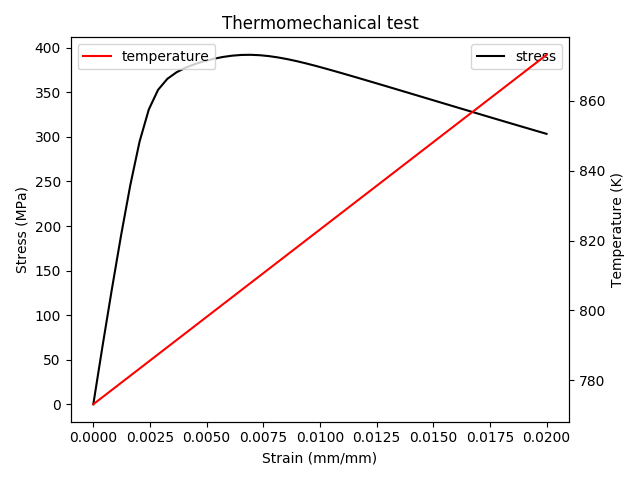
A thermomechanical test is a strain-controlled experiment where both the strain and the temperature are simultaneously changed. This driver takes a collection of time, strain, and temperature points and drives a NEML model through that collection of data, reporting the stress as a function of time.
Driver classes
All the individual drivers use these classes to actually advance the NEML models in uniaxial stress states.
Helpers
These routines are used to help postprocess the results of some of the driver simulations.